
The Foundation: Learning Empathy Through Client Web Design
Before I ever wrote complex Dart state algorithms or orchestrated asynchronous Python microservices, I spent years working on client websites. I started with HTML, CSS, JavaScript, WordPress, and Elementor. That early chapter taught me a foundational lesson that many academically trained software engineers take years to discover: user empathy is the absolute bedrock of good software.
When you build a website for a local entrepreneur or an international e-commerce merchant, you quickly realize that code is merely a delivery vehicle for human business outcomes. If a button takes two seconds to react, if the mobile viewport cuts off text on an iPhone SE, or if the checkout flow creates cognitive friction, your technical stack is completely irrelevant. You have failed the user, and consequently, you have failed the client.
That early discipline profoundly shaped how I approach every mobile interface I build today. It gave me an innate sensitivity to typography hierarchy, optical alignment, whitespace breathing room, animation pacing, and responsive flexboxes. In modern engineering, a developer who understands design systems, layout constraints, and user psychology is worth ten developers who only write functions in isolation without caring about the end-user sensation.
I learned how to communicate technical tradeoffs to non-technical stakeholders, how to translate vague requirements into concrete deliverable milestones, and how to deliver polished digital experiences that inspire trust and drive real commercial conversions.
The Turning Point: Discovering Flutter and Cross-Platform Harmony
As the world shifted decisively toward smartphones, web design alone no longer satisfied my creative ambitions. Businesses across every industry were increasingly asking for native mobile applications. But the traditional mobile development ecosystem was notoriously fragmented, expensive, and frustratingly inefficient.
Building native apps historically meant writing Objective-C or Swift for iOS with Xcode, and Java or Kotlin for Android with Android Studio. For startups, agencies, and independent builders, this meant doubling the engineering budget, doubling the project timeline, and constantly battling parity bugs where the iOS version had features the Android version lacked or behaved differently under edge cases.
Early hybrid web-view solutions like Apache Cordova or PhoneGap attempted to bridge this divide, but the resulting apps felt sluggish, unresponsive, and distinctly un-native. When Google introduced Flutter with its Skia graphics engine and later its revolutionary Impeller runtime, everything changed for me. Flutter did not wrap native platform controls or render in an embedded web view; it drew every pixel directly onto the screen at a locked 60fps or 120fps using hardware-accelerated shaders.
Writing Dart widgets felt remarkably expressive and productive. The declarative paradigm, coupled with sub-second stateful hot reload, allowed me to prototype, iterate, and ship production-grade iOS and Android apps from a single codebase at three times the speed of traditional native engineering.
- Unified single codebase compiling to native ARM machine code for iOS, Android, macOS, Windows, and Web.
- Predictable, declarative widget tree where UI is a mathematical function of state: UI = f(state).
- Hardware-accelerated Impeller rendering engine eliminating shader compilation jank on modern iOS and Android devices.
- Rich type-safe ecosystem with sound null safety, pattern matching, records, and comprehensive automated testing tools.
Bridging the Gap: Mastering Backend Architecture with FastAPI and Python
A mobile application without a robust backend is just a beautiful, static shell. As my freelance projects grew in complexity, I found myself constantly bottlenecked by poorly structured third-party REST APIs. Endpoints returned untyped JSON payloads, lacked proper HTTP status codes, and suffered from unpredictable schema breaking changes that caused mobile apps to crash silently in production.
I realized that to deliver true end-to-end excellence, I needed to master backend engineering myself. I explored Node.js, Express, and Django, but ultimately chose FastAPI. FastAPI combined the unmatched developer speed and AI ecosystem of Python with asynchronous Starlette performance and strict Pydantic v2 data validation.
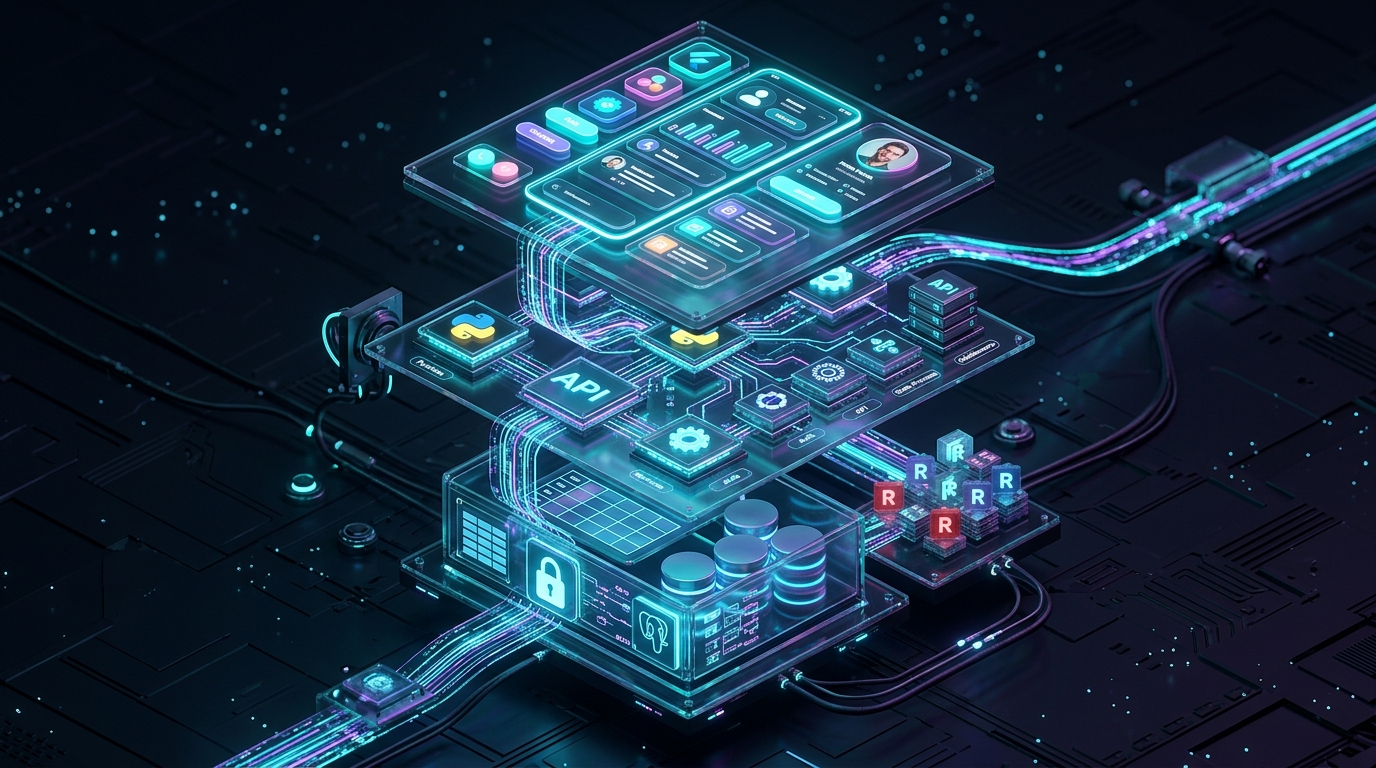
For a Flutter developer, FastAPI is pure paradise. Pydantic request and response schemas mirror Dart data classes with mathematical precision. By exporting FastAPI's auto-generated OpenAPI 3.0 specification, I could use code generators to produce type-safe Dart API clients in seconds, eliminating 95% of client-server serialization bugs before writing a single line of client networking code.
Furthermore, Python's dominance in machine learning and natural language processing allowed me to seamlessly integrate AI capabilities—such as LangChain pipelines, OpenAI embeddings, and custom fine-tuned models—directly into the backend APIs that power my mobile apps.
from fastapi import FastAPI, Depends, HTTPException, status
from pydantic import BaseModel, Field
import uvicorn

app = FastAPI(title="Mobile API Gateway", version="2.0.0")

class DeviceTelemetry(BaseModel):
    device_id: str = Field(..., description="Unique hardware installation identifier")
    app_version: str = Field(..., example="1.4.2")
    battery_level: float = Field(..., ge=0.0, le=1.0)
    screen_width_dp: int

@app.post("/v1/telemetry", status_code=status.HTTP_201_CREATED)
async def ingest_telemetry(payload: DeviceTelemetry):
    # Asynchronously process device metrics without blocking the event loop
    return {"status": "success", "device": payload.device_id}
The Modern Era: Supercharging Workflows with n8n and AI
In recent years, software development entered a seismic transformation driven by artificial intelligence and automated orchestration. I realized that writing repetitive boilerplate code—whether for sending transaction notifications, syncing CRM leads, or transforming data—was a waste of client capital and engineering bandwidth.
I integrated n8n, a self-hostable node-based workflow automation tool, into my full-stack repertoire. By connecting Flutter mobile apps to n8n webhooks and linking them to FastAPI microservices, I began delivering full-featured enterprise platforms in a fraction of the time required by traditional software agencies.
Today, I leverage AI tools not as a crutch to write code I do not understand, but as an intellectual amplifier to explore architectural tradeoffs, generate exhaustive test suites, and automate mundane development chores. This enables me, as a solo engineer from Bangladesh, to compete on equal footing with multi-member global engineering teams.
Final Thoughts
My journey from a small upazila in Sherpur to building mission-critical software for international clients on Fiverr proves that passion, continuous learning, and an unwavering commitment to craftsmanship transcend geography. The tools will continue to evolve, but the core mission remains unchanged: building reliable, human-centered software that solves real problems.
Key Takeaways
- Empathy for the end user and visual design fundamentals are indispensable for modern software engineers.
- Flutter offers the ultimate balance of developer speed, multiplatform reach, and native 120fps performance.
- FastAPI provides the ideal backend companion for mobile apps with strict Pydantic typing and asynchronous concurrency.
- Workflow automation with n8n and AI tools allows solo developers to deliver enterprise-grade software at unprecedented speed.
Frequently Asked Questions
Where did Bayajit Islam start his software engineering journey?
Bayajit Islam began his journey in Jhenaigati, Sherpur, Bangladesh. He started by building responsive websites with HTML, CSS, JavaScript, and WordPress before mastering cross-platform mobile development with Flutter, asynchronous backends with FastAPI, and enterprise workflow automation.
What services does Bayajit Islam provide on Fiverr?
Bayajit provides end-to-end full-stack software development services, including cross-platform iOS and Android mobile app development with Flutter, high-performance RESTful APIs with Python and FastAPI, custom database architecture with PostgreSQL, and workflow automation using n8n.
Why should clients hire a full-stack developer rather than separate mobile and backend engineers?
A full-stack engineer who masters both Flutter and FastAPI understands both ends of the wire. There are zero communication silos, zero finger-pointing between frontend and backend teams, and the API schemas are tailored specifically for optimal mobile network efficiency, caching, and battery life.