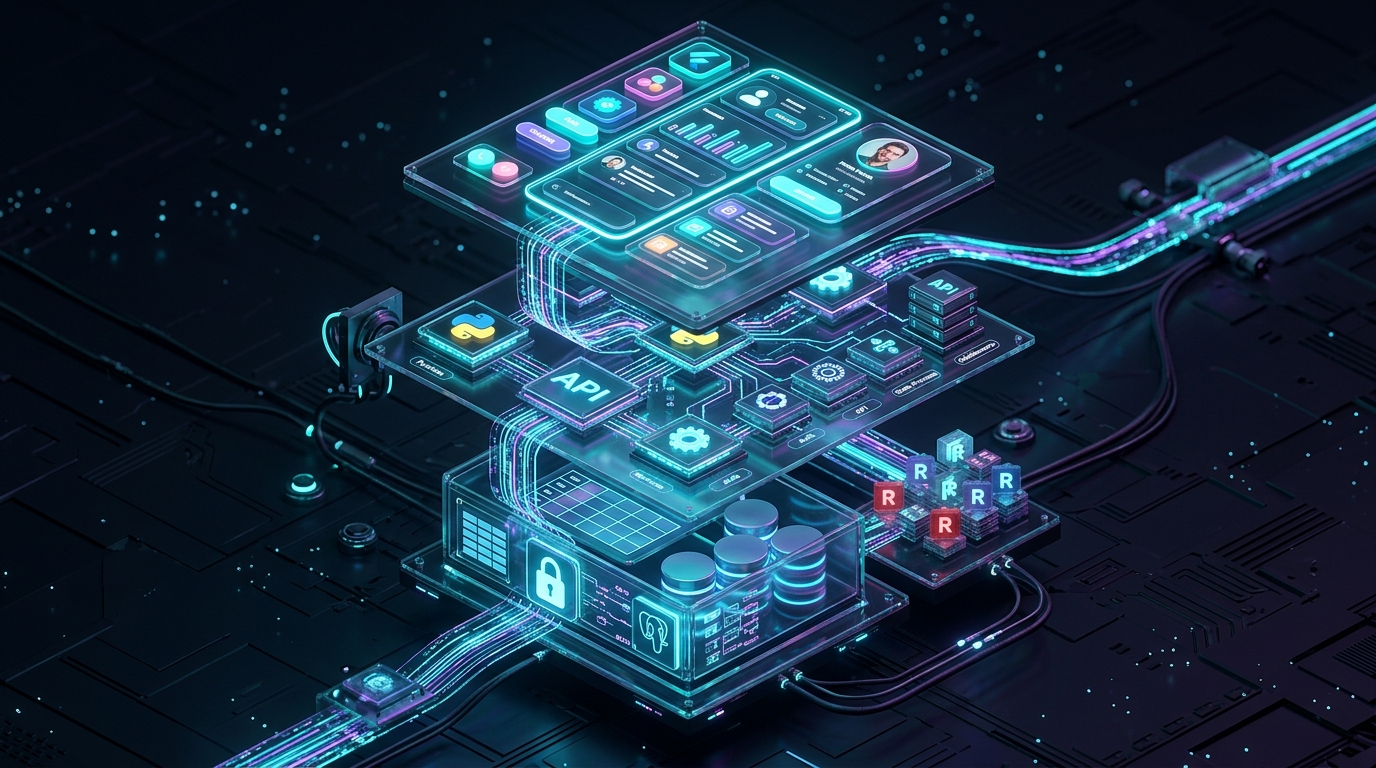

Stage 1: Discovery, Technical Scoping, and Architecture Blueprint
The number one cause of freelance project failure is misaligned expectations. When a client messages me on Fiverr saying, 'I need an Uber for dog walkers' or 'I need a telemedicine app,' jumping immediately into code is a recipe for disaster.
I initiate a comprehensive discovery phase. We break down the product into core user personas, edge-case user flows, third-party API dependencies (Stripe, Twilio, Google Maps), and data modeling requirements. I document every functional deliverable in an interactive Notion roadmap with explicit milestones.
During this stage, I also determine the technical architecture: state management patterns (BLoC or Riverpod), local offline caching strategies (Hive or SQLite), backend data contracts via FastAPI OpenAPI specs, and authentication requirements (OAuth2, Firebase, or JWT).
Stage 2: Translating Figma Designs into Pixel-Perfect Responsive Widgets
Clients frequently arrive with stunning Figma or Adobe XD prototypes created by professional UI/UX designers. The challenge lies in translating static artboards into fluid, interactive, multi-screen mobile experiences.
Rather than hardcoding static pixel dimensions, I extract the design tokens: color palettes, typography hierarchies, elevation shadows, border radii, and spacing scales into a centralized Flutter ThemeData class. Every component is built with responsiveness in mind, supporting everything from compact 4.7-inch iPhone displays to 12.9-inch iPad Pro tablets.
I pay obsessive attention to micro-interactions: tactile haptic feedback on button presses, smooth hero transitions between list and detail views, shimmer placeholder loaders for async data, and graceful error illustrations for empty search results.
Stage 3: Robust State Management and Clean Architecture
A visually appealing app that crashes under real-world network conditions is useless. In my client projects, I strictly enforce Uncle Bob's Clean Architecture principles split across Presentation, Domain, and Data layers.
For complex enterprise applications with heavy reactive data streams, I use the BLoC (Business Logic Component) pattern. For nimble startups requiring rapid feature iteration, I use Riverpod with code generation. Both approaches ensure that business rules are 100% decoupled from the UI widget tree.
This strict separation means that if a client later decides to switch their payment gateway from Stripe to PayPal, or migrate from Firebase to a custom PostgreSQL database, only the data repository layer changes. The user interface remains completely untouched.
Stage 4: Backend API Integration and Offline-First Resilience
Mobile applications operate in an unpredictable physical world. Users step into elevators, commute through subway tunnels, and experience packet loss. An app that hangs indefinitely on a white screen when the internet flickers will receive devastating 1-star reviews.
I design all my mobile apps with an offline-first mindset. Using Dio with custom interceptors, requests are automatically retried with exponential backoff. Critical user data is cached locally using SQLite or encrypted Hive boxes, allowing users to browse products, read saved articles, and draft forms even when completely offline.
When internet connectivity restores, an asynchronous background sync queue flushes pending mutations to the FastAPI backend without interrupting the user's workflow.
Stage 5: Automated Testing, Profiling, and Security Audits
Before delivering an order milestone on Fiverr, the codebase undergoes rigorous verification. I write unit tests for domain use cases, widget tests for critical UI components, and end-to-end integration tests for payment and onboarding flows.
I run the application through Dart DevTools to profile frame rates and memory allocations, ensuring zero memory leaks and locked 60fps or 120fps scrolling. Finally, I conduct security hardening: enforcing SSL pinning to prevent man-in-the-middle attacks, encrypting sensitive tokens using FlutterSecureStorage (Keychain on iOS and EncryptedSharedPreferences on Android), and obfuscating Dart code in release builds.
Stage 6: Store Submission, CI/CD, and Post-Launch Handover
My commitment does not end when the code compiles. Navigating Apple App Store and Google Play Store review guidelines can be an intimidating minefield for clients. I manage the entire publishing pipeline: configuring app bundle identifiers, signing certificates, provisioning profiles, privacy manifest declarations, and store metadata.
I provide clients with clean, thoroughly documented GitHub repositories, complete with README guides, environment variable templates, and automated CI/CD workflows using GitHub Actions or Fastlane. This empowers the client to scale their business with total confidence.
Final Thoughts
Building software on Fiverr is about far more than writing syntax; it is about taking complete ownership of a client's business vision, mitigating technical risks, and delivering reliable digital products that achieve commercial success. That level of dedication is why global clients continue to trust me with their most ambitious mobile products.
Key Takeaways
- Rigorous technical scoping and interactive roadmaps eliminate misunderstandings before writing code.
- Translating Figma into centralized ThemeData ensures responsive consistency across all screen sizes.
- Clean Architecture protects client investments by decoupling business logic from external frameworks.
- Offline-first caching and Dio retry interceptors deliver resilient user experiences even in poor network conditions.
- End-to-end store publishing and CI/CD automation remove friction from app launch.
Frequently Asked Questions
How do you handle client communication across different time zones on Fiverr?
I maintain clear, proactive asynchronous communication with detailed daily Loom video summaries and milestone updates. I overlap working hours with both European and US business hours to ensure rapid responses and seamless collaboration.
What happens if Apple or Google rejects the app during store review?
I provide full review support as part of my delivery commitment. If Apple or Google requests changes regarding permissions, privacy manifests, or in-app purchases, I address the reviewer's feedback and re-submit until the app is fully approved and live on the store.
Can you build both the mobile application and the backend API?
Yes. As a full-stack engineer, I build cross-platform mobile apps with Flutter and architect scalable backend APIs with Python and FastAPI, deploy PostgreSQL databases, and configure automated workflows with n8n.